
Title
Exploratory study on the effectiveness of learning one dance step per day in the workplace to
improve subjective physical and mental well-being.
Authors
Lucy Vincent1, Lesley Kuliukas1, Ravani Duggan1
1. School of Nursing, Midwifery and Paramedicine, Curtin University GPO Box U1987,
Perth, Western Australia, 6845
Funding:
No funding was provided for this study.
Conflict of interest:
Lucy Vincent, as well as a researcher is also unpaid President of a not-for-profit organization
whose objective is to promote movement for well-being and shareholder in a company whose
aim is to provide a well-being program for the general public.
Ethics
Ethical approval was obtained from Curtin University’s Human Ethics Committee (Approval
number HRE2016-0348).
Purpose
Investigation of the power of minimal exercise involving a small cognitive challenge to change
subjective physical and mental well-being.
Design
Responses to a well-being questionnaire were compared before and after 4 weeks of learning a
new dance step a day.
Setting
Staff from a Faculty of Health Sciences at a Western Australian University were invited to learn a
new dance step delivered in video format by email each working day.
Subjects
13.8% staff signed up, 2% male, 98% female, age range 24-69 (average 47.5).
Intervention
Before and after the intervention, subjects filled in the same online well-being questionnaire.
Each morning Monday-Friday they received by e-mail a demonstration video lasting 2 minutes.
Optional daily lunchtime practice sessions were available for 10-15 minutes in a meeting room.
Analysis
Of 100 volunteers, 44 filled in both pre- and post-study questionnaires; their data was compared
using paired student’s t-test.
Results
On a scale of 1-5, subjects evaluated their physical health at 3.00 before and 3.34 after the
intervention (+11.3% p=0.0001), their mental health at 3.20 before and 3.50 after the
intervention (+9.4%, p=0.0001). In an evaluation of 16 symptoms linked to anxiety and
depression, the average score was significantly improved for 9; the remainder showed non-
significant improvements).
Conclusion
Dance provides physical and mental stimulation such that minimal activity, i.e. learning one
step/day, can significantly improve subjective physical and mental well-being. A device to
monitor dance practice duration would enable finer analysis of the specificity of dance effects in
a larger population.Background
The continued decrease in physical activity in the workplace is behind a growing epidemic of
chronic diseases such as metabolic syndrome, cardiovascular diseases, certain cancers [1, 2] and
links are also being made with mental-health issues such as stress, anxiety and depression[3].
However workplace physical activity poses challenges concerning equipment, space, levels of
exertion and motivation. A new approach was therefore conceived based on enjoyment and
cognitive challenge with a view to induce short bouts of regular activity by providing daily two-
minute videos demonstrating a new dance step to be learnt.
Indeed, we now know that short bursts of physical activity can have significant effects on health,
(reducing postprandial glucose and insulin responses by 40% in overweight individuals[4]) and
simply breaking up sitting time makes a difference to health in unfit individuals[5, 6]. This study
investigated whether learning a daily dance move could induce enough physical activity to affect
well-being.
Method
Recruitment
An information e-mail was sent in November 2016 to all staff in the Health Sciences Faculty of a
Western Australian University inviting volunteers with no injuries and with access to video
attachments via email to participate in the study. After signing consent forms and demonstrating
understanding of the introductory information, participants were invited to fill in the pre-study
questionnaire via a Qualtrics anonymous link.
The exercise intervention start date was fixed at 2nd January 2017 and the end date at 27th
January 2017.
The exercise program provided coordination challenges that could be met by practicing for one-
two minutes several times a day. Participants received a demonstration video every working day
by email. The 5 videos delivered Monday to Friday made up a dance; week 1, Disco; week 2,
Bollywood; week 3, Salsa; week 4, Cha-Cha-Cha.
A Project Coordinator normalized this activity by practising the moves with participants in their
office. An optional meeting was organized to practice at 12pm from Monday to Friday for ten to
fifteen minutes.A questionnaire composed of questions previously used to evaluate well-being [7, 8] was filled in
at the start and the end of the 4-week program for comparison.
The subjects accessed the questionnaires via an anonymous link to the Qualtrics website. The
data was analysed using Graphpad Prism.
Ethics
Ethical approval was obtained from Curtin University’s Human Ethics Committee (Approval
number HRE2016-0348).
Results
Participation
One hundred subjects signed up; four withdrew. Thus 96 out of a potential number of 694 staff
(13.8%) took part. Two of the 96 (2%) subjects were males in a faculty in which the percentage
of male staff is 23.5%. Seventy-four participants filled in the pre-study survey and fifty-nine the
post-study survey. Of these, 44 could be identified from both questionnaires using dates of birth
or pseudonyms therefore the data reported here concerns these 44 participants and paired
student’s t-test was applied to determine significance of changes.
Demographics
Of the 44 subjects analysed, 2 were male, 35 earning over 60 000 AUS$/year, 37 in a relationship
and 35 educated to bachelor’s degree level or above.
The age range was 24-69 with an average of 47.5.
Subjective Well-being
“In general how would you say your physical health is at the moment?”
“In general, how would you say your mental health is at the moment?”
Participants responded to there questions on a scale of 1-5, where 1=Poor, 2=Fair, 3=Good,
4=Very Good, 5=Excellent.
Table 1 shows the responses. For both questions, there was a significant improvement in the
average rating at the end of the program in comparison with that at the start.

Symptoms linked to distress
The pre- and post-study questionnaires contained the combined PHQ-9 patient health
questionnaire and GAD-7 general anxiety disorder questionnaire, jointly used to measure
distress, using symptoms linked to depression and anxiety. [7, 8]
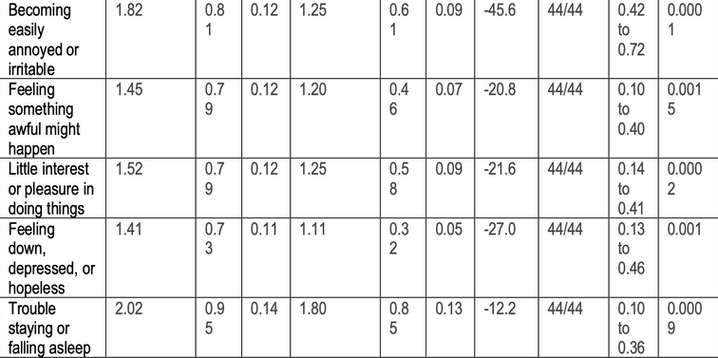
Table 2 shows the results. For all symptoms evaluated, there was an improvement in the average
rating at the end of the study in comparison with ratings at the start. In 9 cases the change is
statistically significant.
Table 2: Over the past two weeks, how much of the time have you been bothered by any of the following?


Discussion
Significant improvements in subjective health were seen in this study: 11.3% in physical and
9.4% in mental well-being and up to 45% in symptoms linked to depression and anxiety.
Moderate or light exercise can affect body and brain function through various mechanisms:
modulation of intestinal hormones[9, 10], corticosteroids[11, 12] or sex steroids[13]; the growth
of brain networks by stimulating neurotransmitters and growth factors[14-17] and by acting on
the immune system, through levels of cytokines [18-20].
These molecules affect sleep[11, 21, 22], digestion[23, 24] and weight control as well as brain
functions such as memory[25], attention[16], cognition[26] and stress control[27]. They also
affect susceptibility to illness as well as tiredness, alertness and depression[28].
The moderate exercise prescribed in this study reduced symptoms of depression and anxiety;
24.3% improvement in “worrying too much”, 17% in “trouble relaxing”, 45.6% in “irritability”, 27% in “feeling down, depressed or helpless”. Other results that could be linked to modified
hormonal environment were the 22.7% improvement in poor appetite or over-eating, the 21.6%
improvement in anhedonia (little interest or pleasure in doing things) and the 12.2%
improvement in sleep disturbances.
We conclude that providing dance videos to stimulate moderate-intensity activity with a
cognitive challenge could be an inexpensive means to combat preventable chronic disease. Thisnow requires validation by a large-scale study incorporating a control (non-dancing) and an
experimental group with the means of measuring actual activity carried out throughout the day
for a more accurate evaluation of the efficacy of this type of activity.
References
1. Henson, J., et al., Associations of objectively measured sedentary behaviour
and physical activity with markers of cardiometabolic health. Diabetologia,
2013. 56(5): p. 1012-20.
2. Wilmot, E.G., et al., Sedentary time in adults and the association with
diabetes, cardiovascular disease and death: systematic review and meta-
analysis. Diabetologia, 2012. 55(11): p. 2895-905.
3. Eyre, H.A., E. Papps, and B.T. Baune, Treating depression and depression-
like behavior with physical activity: an immune perspective. Front
Psychiatry, 2013. 4: p. 3.
4. Dunstan, D.W., et al., Breaking up prolonged sitting reduces postprandial
glucose and insulin responses. Diabetes Care, 2012. 35(5): p. 976-83.
5. Benatti, F.B. and M. Ried-Larsen, The Effects of Breaking up Prolonged
Sitting Time: A Review of Experimental Studies. Med Sci Sports Exerc, 2015.
47(10): p. 2053-61.
6. Swartz, A.M., L. Squires, and S.J. Strath, Energy expenditure of interruptions
to sedentary behavior. Int J Behav Nutr Phys Act, 2011. 8: p. 69.
7. Kroenke, K., R.L. Spitzer, and J.B. Williams, The PHQ-9: validity of a brief
depression severity measure. J Gen Intern Med, 2001. 16(9): p. 606-13.
8. Spitzer, R.L., et al., A brief measure for assessing generalized anxiety
disorder: the GAD-7. Arch Intern Med, 2006. 166(10): p. 1092-7.
9. Lee, S.S. and S. Kang, Effects of regular exercise on obesity and type 2
diabete mellitus in Korean children: improvements glycemic control and
serum adipokines level. J Phys Ther Sci, 2015. 27(6): p. 1903-7.
10. Ebal, E., et al., Effect of a moderate exercise on the regulatory hormones of
food intake in rats. Appetite, 2007. 49(2): p. 521-4.
11. Tortosa-Martinez, J., et al., Exercise Increases the Dynamics of Diurnal
Cortisol Secretion and Executive Function in People With Amnestic Mild
Cognitive Impairment. J Aging Phys Act, 2015. 23(4): p. 550-8.
12. van Oosterhout, F., et al., Amplitude of the SCN clock enhanced by the
behavioral activity rhythm. PLoS One, 2012. 7(6): p. e39693.
13. Sato, K., et al., Responses of sex steroid hormones to different intensities of
exercise in endurance athletes. Exp Physiol, 2016. 101(1): p. 168-75.
14. Ben-Soussan, T.D., et al., Increased cerebellar volume and BDNF level
following quadrato motor training. Synapse, 2015. 69(1): p. 1-6.
15. Schmidt, R.H., J.M. Nickerson, and J.H. Boatright, Exercise as Gene Therapy:
BDNF and DNA Damage Repair. Asia Pac J Ophthalmol (Phila), 2016. 5(4):
p. 309-11.
16. Muller, P., et al., Evolution of Neuroplasticity in Response to Physical
Activity in Old Age: The Case for Dancing. Front Aging Neurosci, 2017. 9: p.
56.17. Hakansson, K., et al., BDNF Responses in Healthy Older Persons to 35
Minutes of Physical Exercise, Cognitive Training, and Mindfulness:
Associations with Working Memory Function. J Alzheimers Dis, 2017.
55(2): p. 645-657.
18. Lunde, L.K., et al., Physical activity initiated by employer induces
improvements in a novel set of biomarkers of inflammation: an 8-week
follow-up study. Eur J Appl Physiol, 2017. 117(3): p. 521-532.
19. Spartano, N.L., et al., Associations of objective physical activity with insulin
sensitivity and circulating adipokine profile: the Framingham Heart Study.
Clin Obes, 2017. 7(2): p. 59-69.
20. Eyre, H. and B.T. Baune, Neuroimmunological effects of physical exercise in
depression. Brain Behav Immun, 2012. 26(2): p. 251-66.
21. Naylor, E., et al., Daily social and physical activity increases slow-wave sleep
and daytime neuropsychological performance in the elderly. Sleep, 2000.
23(1): p. 87-95.
22. Harrington, M.E., Exercise strengthens circadian clocks. J Physiol, 2012.
590(23): p. 5929.
23. Belcher, B.R., et al., Effects of Interrupting Children's Sedentary Behaviors
With Activity on Metabolic Function: A Randomized Trial. J Clin Endocrinol
Metab, 2015. 100(10): p. 3735-43.
24. Christensen, C.S., et al., Skeletal Muscle to Pancreatic beta-Cell Cross-talk:
The Effect of Humoral Mediators Liberated by Muscle Contraction and
Acute Exercise on beta-Cell Apoptosis. J Clin Endocrinol Metab, 2015.
100(10): p. E1289-98.
25. Ratey, J.J. and J.E. Loehr, The positive impact of physical activity on
cognition during adulthood: a review of underlying mechanisms, evidence
and recommendations. Rev Neurosci, 2011. 22(2): p. 171-85.
26. van der Niet, A.G., et al., Associations between daily physical activity and
executive functioning in primary school-aged children. J Sci Med Sport,
2015. 18(6): p. 673-7.
27. Nair, S., et al., Do slumped and upright postures affect stress responses? A
randomized trial. Health Psychol, 2015. 34(6): p. 632-41.
28. Dantzer, R., et al., From inflammation to sickness and depression: when the
immune system subjugates the brain. Nat Rev Neurosci, 2008. 9(1): p. 46-
56.